

Why Do Construction Companies Still Use Paper?
A construction company can invest in sophisticated design software and still depend on a clipboard to establish what happened on site.
Drawings may be digital, yet inspections, attendance, delivery records and approvals continue to move through handwritten forms, photographs and spreadsheets. The technology has arrived. The working culture has not necessarily moved with it.
Why does this gap persist?
The question deserves more attention than a simple explanation that construction is resistant to change. Paper’s continued presence can reveal a disconnect between the software a business purchases, the conditions in which its people work and the behaviours its management rewards.
Recent market surveys conducted by Adecore highlights a discussion of workforce management identifies familiarity, apparent affordability and concern about disruption as reasons companies retain manual processes. Its central observation is practical: a system that adds work or fails to understand or reflect site conditions will struggle to gain acceptance.
These explanations should prompt investigation, not acceptance of the status quo. Every time information must be carried, retyped or chased before someone can act, the company should examine the consequences for delivery.
At Adecore, we see this as a question of how intelligence becomes useful. Information must reach someone who can interpret it, make a decision and take responsibility for what happens next. A completed form, whether physical or digital, is only the beginning.
The Challenge
Paper can appear efficient because its immediate demands are small.
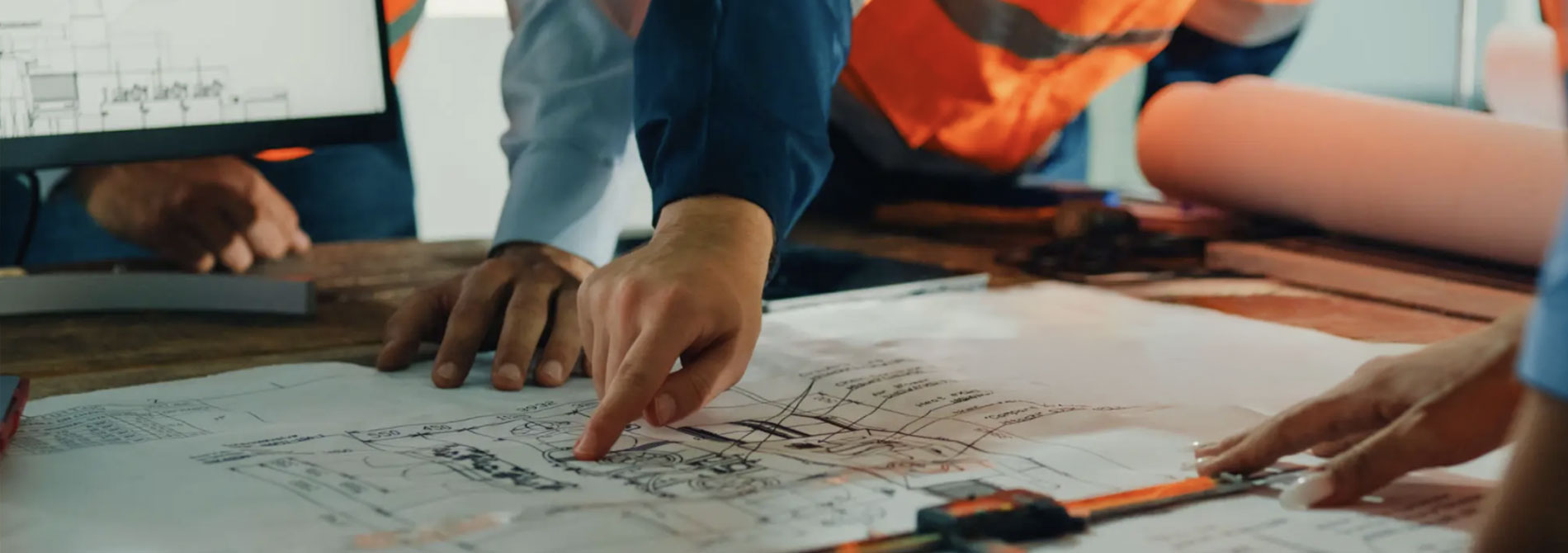
Paper can appear efficient because its immediate demands are small. A supervisor writes a note, signs a sheet and returns to work. The wider cost emerges elsewhere, when an administrator interprets the handwriting, a commercial manager searches for supporting evidence or another team repeats an inspection because the original record cannot be located.
This creates an uneven distribution of effort. The person recording information may experience little of the downstream delay. Equally, a new application may save head office time while requiring the supervisor to complete additional fields. Unless implementation addresses both sides, resistance can be a response to work being redistributed without agreement.
The technology itself may also introduce friction. Consider an illustrative situation: a subcontractor records an inspection in its own system, enters the same details into the main contractor’s portal and retains a signed sheet because the client still requests it. Three records exist, but the project has gained no clear answer about which one governs the next activity.
A paperless process can reproduce precisely this confusion through disconnected applications.
Culture introduces another layer. If managers continue to request printed summaries, bypass digital approvals or act on private messages, employees receive a clear signal about where decisions really happen. Training people to use an application will achieve little if leadership continues to operate outside it.
Trust matters just as much, where employees believe that recording a problem will invite blame, faster reporting tools may produce faster concealment. Where reporting leads to assistance and timely decisions, participation has a more credible purpose. Construction leaders should examine how they respond to unwelcome information before assuming that incomplete records reflect poor digital skills.
Smaller contractors face an additional participation question. In Australia, we can also see a substantial difference between small and large firms in their adoption of specialist quality and compliance software. Regardless of regulation tightening over the last four years, this raises a useful question for any project: can every required participant realistically understand and use a chosen process?
For African projects, this assessment should examine the actual conditions at each site, including connectivity, device access, language, subcontractor capacity and available support. These conditions must be established through evidence rather than assumed across a diverse continent. Regardless of locality, one thing is for certain, without leadership, training and policy changes within a company, this transformation cannot occur.
Our Approach
Adecore would begin by following one consequential record through the business.
Adecore would begin by following one consequential record through the business. An inspection request, delivery confirmation or site instruction can expose more than a broad inventory of software licences. Who creates it? Who checks it? Where does it wait? What decision depends on it? How does the person who raised it learn that action has been taken?
This investigation should distinguish observed problems from management assumptions. A claim that employees resist technology might conceal unreliable connectivity, unclear approval authority or a form that takes too long to complete. Each cause requires a different response.
The next step is to define a specific improvement. For an inspection process, this might mean reducing the time between a request and an authorised decision while preserving the evidence needed to understand that decision. The business should establish its starting position before setting a target.
Adecore would then bring the company owner, site users, supervisors, commercial teams and relevant subcontractors into the design. Every requested field should serve a clear purpose. Users should be able to complete the task under actual working conditions and see its progress without making repeated calls. Where offline working is necessary, the process should make unsynchronised records visible and define how conflicting updates are resolved.
Responsibility must be equally clear. A notification needs an owner, an expected response and an escalation route. An uploaded record should not automatically imply permission to proceed. Receipt, review and authorisation should remain distinguishable wherever those differences affect the work.
Consider a hypothetical inspection before concrete placement. A useful digital process would connect the request to the relevant location and drawing revision, identify the authorised reviewer, record outstanding issues and communicate the resulting decision to the delivery team. The value lies in the reliable sequence from evidence to action.
Implementation should begin with a manageable pilot involving ordinary users, including those who are less confident with technology. Adecore would assess completion time, missing information, approval delays, repeated entry and the continued use of unofficial workarounds. Login counts alone would provide little evidence that the business had improved.
During transition, any necessary paper fallback should have a defined purpose and a reconciliation process. Once the digital workflow demonstrates reliable performance and applicable project requirements are addressed, redundant duplication should be retired. Otherwise, the business risks paying for both systems indefinitely.
Leadership must participate in that transition. Managers should use the agreed records, respond through the defined process and provide time for learning. The organisation should retain trained internal owners who can support new starters, resolve problems and improve the workflow after implementation.
This is how Adecore connects intelligence with positive impact. Human impact should be assessed through usable tools, stronger capability and reduced administrative burden. Economic impact should be tested through time recovered, fewer avoidable delays and better supporting evidence for commercial decisions. Institutional impact should appear in clearer authority, traceable decisions and continuity when personnel change. Environmental impact should be examined through measurable reductions in avoidable rework and material waste, alongside any reduction in printing. These outcomes require evidence; they do not follow automatically from purchasing software.

Adecore Insight
The persistence of paper should make construction leaders curious about the organisation behind it.
A clipboard may reveal that the official application is cumbersome. A private spreadsheet may expose a missing connection between systems. A printed approval may show that people do not trust the digital record. Each workaround offers evidence about where the intended process has failed to become the accepted way of working.
The leadership task is to investigate that evidence and remove the underlying obstacle. This requires commercial judgement, practical technology and sustained attention to behaviour.
A useful test is to ask a supervisor, a subcontractor and a commercial manager to reconstruct the same recent decision. Can they establish what was requested, which information applied, who authorised the response and what happened afterwards? Their answers will reveal whether the business has built a dependable shared record.
Construction companies move beyond paper when the agreed digital process becomes a reliable way to complete real work, obtain decisions and demonstrate responsibility. For Adecore, that is the point at which information begins to create lasting value: people can act with greater confidence, management can verify the outcome and the organisation retains the capability to improve.