

Turning a National Technology Agenda into a Delivery System
A national strategy can describe the right future while leaving the machinery for delivering it unresolved.
A ministry announces a digital service, an agency procures a platform and a district office receives new reporting requirements. Each action appears consistent with the agenda. Yet the citizen may still travel between offices because the organisations have not agreed who can accept evidence, make a decision or resolve an exception.
The challenge is to structure national ambition as an operating programme. Technology is one component alongside authority, public finance, staff capability and service design. A useful agenda explains how these components will work together through ordinary conditions, changes of leadership and periods when funding or connectivity is constrained.Its credibility rests on the route from commitment to delivery.
The World Bank's digital-government work identifies digital identity, payments and trusted data sharing as reusable foundations for services, alongside interoperable architecture and institutional capacity. This provides a useful basis for thinking across ministries rather than procuring every service as an isolated system.
Adecore would begin with the outcome the public should experience. If the goal is to help an agricultural enterprise obtain an operating approval more predictably, success means an accessible and accountable decision process. The number of portals launched would be a delivery activity, not the principal measure of national progress.

The Challenge
National programmes frequently contain objectives that pull in different directions.
National programmes frequently contain objectives that pull in different directions. An agency may be asked to recover costs, expand access, support local suppliers and reduce processing time. These goals can coexist, but choices about fees, staffing and procurement expose trade-offs. If no authorised body resolves them, the technology team is left to embed policy decisions in software without a clear mandate.
Research by Combs, Yao, Liu and Xiao provides a relevant caution about institutional ambiguity. Their study of Chinese listed firms found weaker innovation outcomes among firms affiliated with middle-level governments, with international diversification mitigating that disadvantage. The findings concern a particular corporate and institutional setting, while they do not establish that a specific tier of African government is less innovative.
For a national technology agenda, the useful inference is to examine how competing instructions and fragmented resources affect delivery. A state enterprise can receive equipment while lacking an agreed service mandate or the budget to maintain it. An implementing agency can be held responsible for a deadline while another organisation controls the information needed to meet it. Reporting these dependencies does not resolve them unless someone can act.
Data integration has similar institutional limits. Two systems may exchange records while their operators interpret the same field differently. A payment can be marked complete in one organisation and unreconciled in another. A shared identifier may improve matching without establishing whether access to the underlying information is lawful or appropriate. Technical connectivity must therefore be accompanied by agreed meanings, purposes and responsibilities.
The people least visible in administrative data may also be those most affected by a reform. A digital-only process can reduce measured processing time by excluding applicants who cannot complete registration. A responsible programme needs to understand non-completion, assisted access and appeal, rather than treating successful online transactions as a complete account of public experience. Evidence should include the people the system fails to serve.

Our Approach
Adecore would translate the national objective into a small number of service outcomes with accountable owners.
Adecore would translate the national objective into a small number of service outcomes with accountable owners. Each outcome would have a baseline, a defined population and an explanation of how improvement will be assessed. For an enterprise approval, the record might distinguish time spent waiting for the applicant, time awaiting an inter-agency response and time awaiting an authorised decision. This allows the programme to address the actual source of delay.
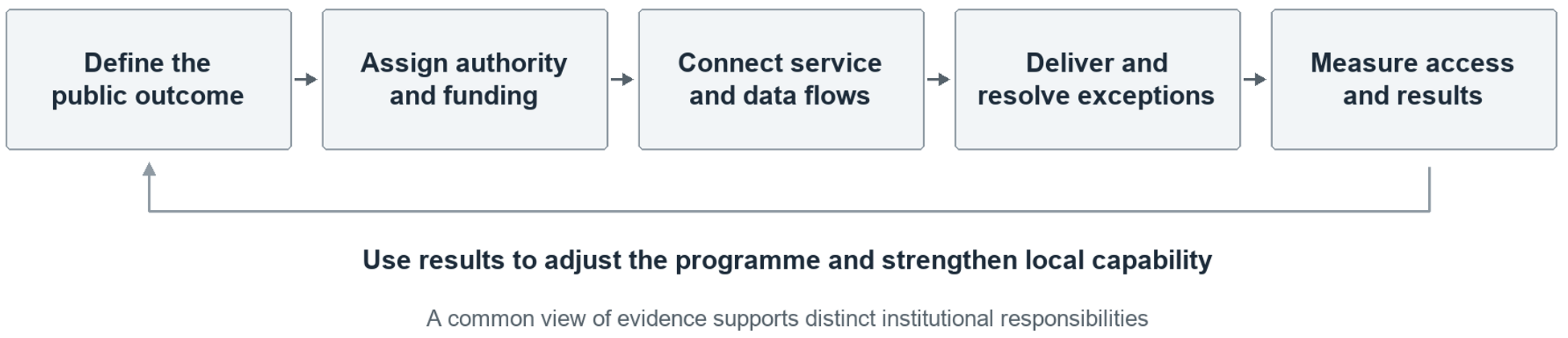
The delivery structure would identify the lead institution, participating agencies, funding authority and escalation route. Responsibility would follow the power to decide. Where a programme board coordinates several bodies, its mandate would specify which matters it can settle and which require ministerial, legislative or other lawful action.Institutional clarity should precede a system configuration that would otherwise harden unresolved disagreements.
We would map the service from the user's first contact to completion and review. The common evidence record would identify the case, event time, status, responsible organisation, decision basis and unresolved dependency. Agencies would retain appropriate custody of source records while sharing only the information required for the service. A unified view need not mean copying every record into one unrestricted national database.
Budget design would include operation, support, security, training and replacement, as well as acquisition. Funding releases would be connected to verified capability and service readiness. A demonstration environment is different from a staffed service that can handle exceptions. The programme would test continuity during outages and personnel changes, ensuring that alternative channels preserve a traceable account of decisions rather than generating an invisible parallel process.
Procurement would be sequenced around the architecture and the institutions' capacity to absorb change. Shared components would have an identified operator and service obligations. Specialist systems would be required to exchange agreed information through workable interfaces.Acceptance would test the complete journey across organisational boundaries, including failed transactions and corrections, rather than allowing each supplier to demonstrate only its own component in isolation.
Performance reviews would connect operational indicators to public outcomes. Faster case handling should be considered alongside access, error correction, user costs and the quality of decisions. Where feasible, staged implementation can help distinguish reform effects from wider economic changes. The evidence should show which groups benefit, which remain excluded and what the programme will change in response.Local capability transfer would be assessed through tasks staff can perform independently.
The programme would also maintain a record of material assumptions. Expected demand, staffing levels and partner readiness should have review dates and named owners. When an assumption proves wrong, leaders need to see which commitments are affected and what adjustment is proposed. This creates a disciplined route for adaptation, so the national agenda can remain coherent while implementation changes in response to evidence from districts, agencies and service users.

Adecore Insight
The strategic value of a national technology agenda lies in its ability to coordinate institutions around outcomes that no single organisation can deliver alone.
The strategic value of a national technology agenda lies in its ability to coordinate institutions around outcomes that no single organisation can deliver alone. This requires more than a central dashboard. It requires decisions about authority, funding and service responsibility that make the dashboard's information actionable. The architecture of government delivery should be understandable before the digital architecture becomes expensive to change.
Human impact is visible when citizens can access a service, understand a decision and seek correction without unreasonable burden. Economic impact can include lower administrative costs and more predictable business operations, but those benefits need to be measured. Institutional impact appears in consistent records, capable public servants and continuity across leadership changes. Environmental considerations belong where the programme materially affects energy, equipment use or resource management.
A programme should be able to explain why it is stopping an unsuccessful pilot as clearly as why it is expanding a successful one. Public value is not served by defending a platform simply because it has already been announced. Credible governance allows evidence to change the implementation plan while preserving the public purpose.
Adecore's role would be to connect that purpose to a workable delivery system. The enduring outcome is a government that can commission, operate, evaluate and improve its services with greater confidence.Technology becomes part of national capability when the institution can use it responsibly after the launch team has left.