

Revenue Pooling in Public Transport: What Would Make Operators Trust It?
Revenue pooling asks operators to make a significant change: accept payment through a collective arrangement rather than rely solely on the passengers carried by their own vehicle.
In return, the model may support coordinated service, more predictable earnings and less competition for individual fares. The proposition can be attractive, but it depends on trust in the rules and the institution applying them. Without that trust, a common account can become a common source of conflict.
The central issue is not whether pooling is technically possible. Digital systems can record journeys and calculate distributions. The harder question is whether participants regard the arrangement as legitimate, understandable and fair enough to sustain. Operators need confidence that others are contributing, records are reliable and decisions cannot be changed arbitrarily. They also need to know who absorbs a shortfall when the pool earns less than expected.

The Challenge
Participants may contribute vehicles of different sizes, conditions and costs. Some may serve busy routes while others provide essential but less remunerative coverage.
Participants may contribute vehicles of different sizes, conditions and costs. Some may serve busy routes while others provide essential but less remunerative coverage. A formula based only on kilometres can overlook vehicle capacity or service quality. A formula based only on passengers can preserve competition for the busiest trips. The allocation method therefore influences behaviour, not just payment. Its design should reflect the service the collective organisation is trying to provide.
Information asymmetry can undermine the arrangement. Operators may suspect that another participant reports journeys that were not completed or avoids less attractive assignments. The entity managing the pool may possess more detailed records than the people whose income depends on them. Even an honest process can lose support if participants cannot understand it. Transparency needs to be sufficient for meaningful scrutiny without exposing every piece of commercially or personally sensitive information.
The scheme also needs a clear answer to revenue risk. A collective pool is not necessarily a guarantee of payment. If receipts decline, distributions may fall unless another party has agreed and can afford to cover the difference. Participants should understand whether they are sharing variable revenue or receiving a contractual payment for service.Confusing these models can produce expectations that the financial structure cannot meet.
Governance disputes can become operational disputes quickly. A participant who believes an allocation is unfair may withhold vehicles, retain cash or ignore dispatch instructions. The resulting loss of service can reduce total revenue and deepen the disagreement. The system needs a credible way to resolve problems before they threaten the collective operation. A technical audit trail helps, but it must be connected to an institution with authority and legitimacy.

Our Approach
Adecore would begin by defining the service objective and the participants' existing economics.
Adecore would begin by defining the service objective and the participants' existing economics. Pooling should solve an identified problem, such as destructive competition or inability to coordinate departures. The assessment should then examine what each participant contributes and what it needs to remain viable. This provides the basis for comparing allocation models rather than beginning with a preferred formula and expecting the sector to accommodate it.
An illustrative pool can show why the design matters. Suppose two operators each complete 100 kilometres, but one uses a larger vehicle on a heavily loaded corridor while the other serves a low-demand feeder. Equal kilometre payments may support the feeder but fail to recognise differences in capacity or cost. Passenger-based payments may disadvantage the feeder even though it strengthens the network. Neither result establishes the right answer. The example reveals the policy and commercial choices embedded in the formula.
Before implementation, candidate rules should be tested against representative operating periods and plausible disruptions. Participants should see how distributions change when demand falls, a vehicle breaks down or a service assignment changes. This makes the risk allocation tangible. Independent review may help establish confidence, but the process must remain understandable to the people who will live with its consequences. Complexity should have a demonstrable purpose.
Participants should agree how shared costs are approved and reported. A pool may fund administration, technology or common facilities, but the authority to incur those costs should not be unlimited. Operators need a budget, a reporting process and a way to review material changes. This helps distinguish legitimate collective expenditure from deductions perceived as arbitrary. The governance design should also identify conflicts where a decision-maker has an interest in a supplier or service paid from the pool.
The institution should explain how participants can inspect the evidence supporting their own allocation and how recurring discrepancies will trigger a review of the underlying process.
Adecore's impact framework asks whether the arrangement improves service and participation together. Human outcomes include reliable journeys and fair treatment of crews. Economic outcomes include sustainable distributions and fewer incentives to undermine coordination.Institutional outcomes include transparent governance, auditability and enforceable responsibilities. Environmental effects depend on how the pooled operation changes deployment and resource use. The existence of a shared account is not itself evidence of those outcomes.

Adecore Insight
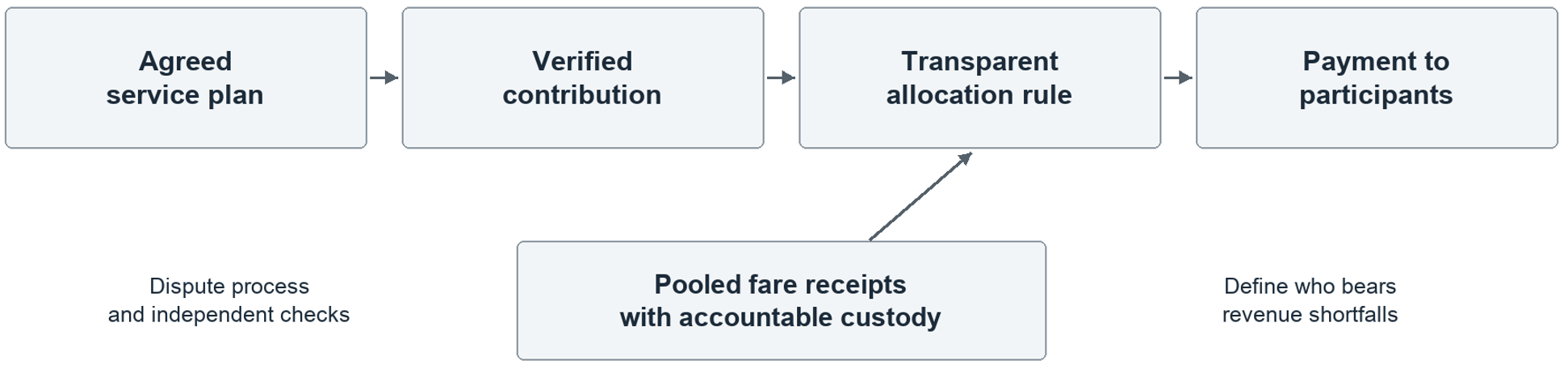
A sound scheme separates the rules for service allocation from the rules for payment and makes their relationship explicit.
A sound scheme separates the rules for service allocation from the rules for payment and makes their relationship explicit. If one institution assigns work and another calculates earnings, their responsibilities must be coordinated. Participants should know how decisions are challenged and whether a dispute suspends payment or service obligations. The objective is to prevent ordinary disagreements from becoming a reason to leave the whole arrangement.
Verification should be proportionate to the risk of error or manipulation. Vehicle location, dispatch records and passenger transactions may each provide useful evidence, but none should be treated as infallible. The scheme needs procedures for missing data and legitimate exceptions. A vehicle diverted around an incident should not automatically be treated as non-compliant because its trace differs from the planned route. Fair review protects the credibility of the controls.
Reserves and shortfall arrangements should be discussed openly. If the pool retains funds for maintenance, seasonal variation or contingencies, participants need to understand the purpose, ownership and conditions for use. If a reserve is exhausted, the next decision should be known. An undisclosed deduction or improvised call for additional contributions can damage confidence even where the underlying financial need is real.
Entry and exit matter as much as launch.New operators need qualification rules, and departing participants need a clear process for settling obligations. The arrangement should consider the impact of losing a large contributor or adding capacity faster than demand grows. These are commercial resilience questions. A scheme that works only while its original membership remains unchanged may be poorly suited to an evolving urban transport market.
Trust can be strengthened through a staged introduction in which participants compare the proposed allocations with existing earnings before the arrangement becomes fully binding. Such a period needs careful design because historic earnings are not necessarily the correct future entitlement. Its value is to reveal differences, test records and discuss the reasons for change. A transparent transition allows participants to understand the consequences and gives the institution an opportunity to correct errors before they affect livelihoods or create a wider dispute.
Pooling becomes credible when participants can see how their contribution supports a shared service and how their income is determined. It requires governance capable of handling disagreement without collapsing into informal bargaining. Adecore's role is to help make those relationships explicit and executable. The lasting value is a collective operation that earns trust through evidence and fair process, while delivering a service no participant could organise as effectively alone.