

One Ticket Across Many Operators: Who Gets Paid, and Who Carries the Risk?
For a passenger, an integrated ticket promises a simpler journey. One payment method can connect a feeder service, a main corridor and a final transfer without requiring a new transaction at every stage.
Behind that convenience sits a more complicated question: how is the revenue divided among the organisations that made the journey possible? The passenger experiences one service, while the operating and financial responsibilities may remain distributed across several institutions.
Interoperability allows systems to exchange information or accept a common credential. Integration also requires agreement about fares, entitlements, settlement and accountability. A validator can recognise a card without resolving who should fund a discounted transfer or absorb an unpaid journey. The commercial design therefore matters as much as the technical connection. If those arrangements are weak, a seamless passenger experience can conceal persistent disputes between the operators expected to sustain it.

The Challenge
A simple proportional split can appear fair while undermining the economics of a low-volume feeder service that the wider network depends on.
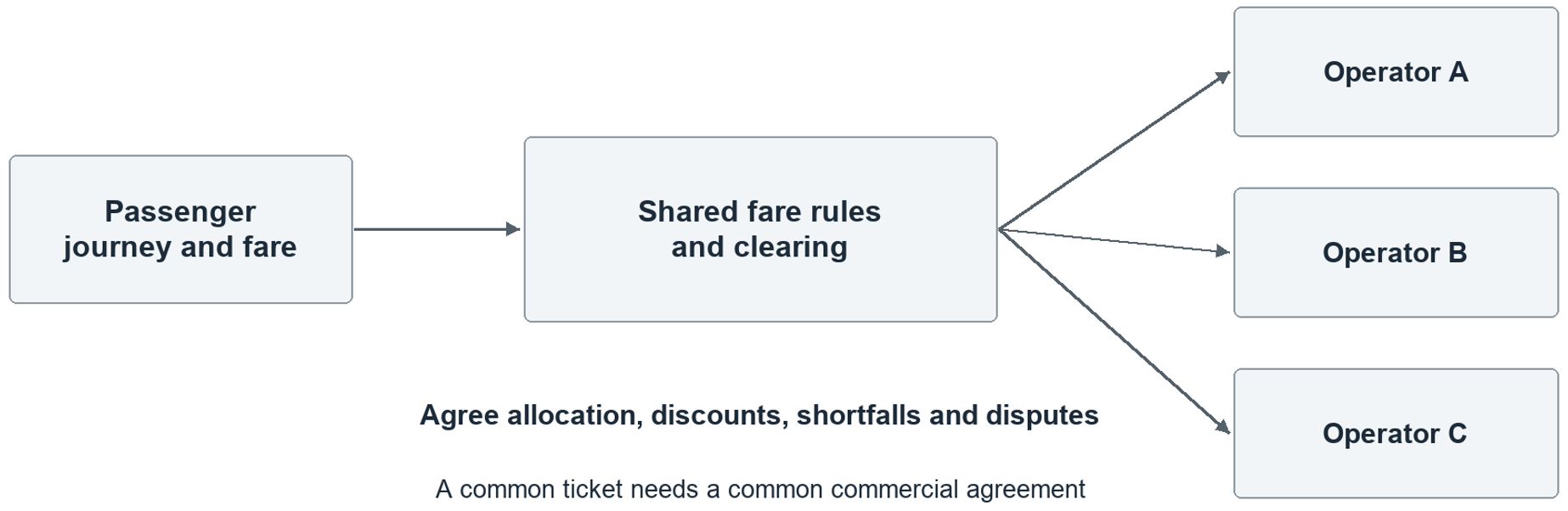
Consider an illustrative journey involving two operators under a combined fare. Charging the passenger less than the sum of two separate tickets may encourage use, but the discount must be allocated somewhere. One operator may carry the longer distance, another may provide the essential connection and both may face different costs. A simple proportional split can appear fair while undermining the economics of a low-volume feeder service that the wider network depends on.
Revenue risk complicates the allocation. Some operators may be paid for delivered service, while others retain fare receipts and carry demand risk. A common ticket does not automatically make these models compatible. The scheme must explain which institution bears a shortfall between passenger revenue and contractual payments. If no one has accepted that exposure explicitly, the gap will emerge later through delayed settlements, renegotiation or reduced service.
Incomplete journey records create another layer of difficulty. A missed validation, equipment failure or disrupted transfer can leave uncertainty about what service was used. Rules for estimating, correcting or disputing those records need agreement before volumes grow. Otherwise, participants may interpret the same event in ways that favour their own revenue. Technical exceptions then become commercial conflicts, and passengers may be asked to compensate for problems they did not create.
The scheme can also concentrate power in the institution controlling clearing and settlement. Operators may depend on its calculations while having limited visibility into the underlying rules. Trust requires more than assurances that the software is accurate. Participants need a way to understand allocations, challenge errors and assess proposed changes. A payment network is also a system of economic relationships, and its legitimacy depends on how those relationships are governed.

Our Approach
Adecore begins by describing the passenger journeys the programme is intended to improve.
This establishes the practical purpose of integration before selecting an acceptance technology. The work then maps the operators, fare rules, service contracts and money flows behind those journeys. Differences in commercial models become design questions rather than problems deferred until implementation. The result should show how the passenger proposition can be sustained by the participating businesses.
Allocation options should be tested using representative journey and cost information. The objective is not to find a mathematically elegant formula in isolation. It is to understand how each option affects service viability, incentives and the public funding requirement, where applicable. A rule that rewards unnecessary distance or discourages transfers may undermine the network objective. Scenario testing helps make these effects visible before they become embedded in contracts and systems.
Governance should define who can change fares, allocation rules and settlement arrangements. Material changes need a process that recognises their effects on different participants and preserves an auditable decision record. The scheme also needs clear responsibilities for reconciliation, complaints and outages. A common operating language is essential so a payment provider, transport authority and bus company do not use the same term to mean different stages of financial completion.
A common fare also needs an explicit policy on concessions and discounts. A student entitlement, daily cap or promotional transfer can affect operators differently depending on who carries the eligible journeys. The scheme should identify how eligibility is verified, how the discount is funded and how disputes are corrected. These choices belong in the commercial design before they are coded. Otherwise, a passenger benefit may create an unrecognised obligation for an operator whose contract assumed a different revenue basis.
Adecore's impact assessment connects these arrangements to outcomes. Human impact concerns journey affordability and ease of use. Economic impact concerns viable participation and efficient service delivery. Institutional impact concerns transparent decisions and a credible means of resolving disagreement. Environmental benefits may follow if better integration changes travel behaviour or improves fleet use, but they require evidence. Acceptance of one ticket across several vehicles is a capability, not proof of every hoped-for benefit.

Adecore Insight
An integrated scheme should be tested through difficult journeys as well as ordinary ones.
A passenger who changes vehicles after a breakdown, misses a connection or is charged incorrectly reveals whether responsibility has genuinely been integrated. The customer should have a clear route to resolution even when several organisations are involved. Internal allocation disputes should not require the passenger to reconstruct the institutional structure behind the journey.
The commercial model needs to recognise services that create network value without generating the strongest direct receipts. A feeder route may improve access to a main corridor while remaining financially weak on its own. If the programme expects that service to continue, it must establish a viable payment arrangement and identify who funds it.Hiding the obligation inside optimistic assumptions about future ridership only postpones the decision.
Procurement should preserve the ability to change components without destabilising the scheme. Data definitions, interfaces, access rights and exit arrangements affect whether the authority can replace a provider or add an operator. These matters deserve attention before the first contract is signed. Technical openness is useful only when the commercial and operational arrangements allow it to be exercised in practice, with continuity for users and participants.
A pilot should therefore include settlement between real participants, a disputed allocation and a controlled failure scenario. It should establish whether the rules can be explained and applied by the people who will run the service. Testing only the passenger-facing transaction leaves the most consequential institutional questions unanswered.The programme should expand when the operating relationships are ready, not merely when the devices can recognise the same credential.
Integration should be introduced in a sequence that the institution can govern. Connecting a small set of operators with clear rules may create more useful learning than announcing universal acceptance before settlement is ready. The expansion criteria should include reconciliation quality, complaint resolution and participant confidence alongside technical performance. This provides a responsible path to scale. It also gives new entrants a clearer proposition because the scheme can demonstrate how its arrangements work in practice, rather than asking them to join on the strength of an aspiration alone.
The value of one ticket is ultimately the value of a better-connected journey. Achieving it requires institutions to agree how the benefits, costs and risks are shared. When those agreements are visible and workable, technology can make integration convenient at scale. When they are absent, the system may connect payment devices while leaving the organisations behind them in conflict. Intelligence becomes impact when it helps close that gap.