

Making Site Data Useful Before a Change Becomes a Claim
Construction technology can help close a critical gap by connecting evidence to authority before commitments become difficult to reverse.
A site team discovers that a service route conflicts with an element already installed. Photographs are taken, messages circulate and a revised drawing appears. Work continues while commercial approval remains uncertain. Weeks later, the parties disagree about who instructed the change, which version was current and whether the additional time and cost were avoidable. The project had abundant information, but an incomplete decision record.
Construction technology can help close this gap when it connects evidence to authority before commitments become difficult to reverse. A building information model, mobile inspection tool or progress dashboard is useful only if the people using it understand its status and the action it permits. The central question is whether a verified issue reaches the right decision-maker while options remain available.
The UK BIM Framework's guidance on the common data environment treats information management as a combination of workflow and enabling technology. Its discussion of revision and status controls is relevant to the distinction between information shared for coordination and information authorised for a particular use. The published guidance is a reference for project design, not a statement that every African contract adopts identical requirements.
Adecore approached construction digitisation through a live decision such as a proposed change. The objective was be to preserve a coherent account from observation through technical assessment, authorised instruction, execution and verification.
The Challenge
Site information often reaches the project through different channels. A survey, a subcontractor's photograph and a designer's model may use different dates, locations or identifiers.
Site information often reaches the project through different channels. A survey, a subcontractor's photograph and a designer's model may use different dates, locations or identifiers. A picture can show that something exists without establishing its specification, acceptance or concealed condition. Automated progress analysis can estimate visible completion while missing work that cannot be observed from the chosen viewpoint. Evidence needs to be assessed for the decision it is expected to support.
Version control is equally consequential. The latest uploaded drawing may be a draft rather than the latest authorised instruction. A team can work from a recent file and still work from the wrong basis. If status is unclear, better connectivity can spread the error more quickly. The project needs an accessible way to distinguish current authorised information from material still under review.
Technical and commercial authority may also sit with different people. A designer can explain a solution without having authority to instruct a change under the contract. A site manager may need to make an immediate area safe while wider cost and programme implications remain unresolved. These responsibilities should be understood in advance. Software should make the distinction visible rather than implying that every acknowledged message constitutes approval.
The incentive to keep work moving can conceal incomplete decisions. Teams may defer recording a variation because agreement appears imminent, or report progress without separating completed, inspected and accepted work. The resulting dashboard looks reassuring until the commercial review exposes the difference. Real-time reporting is valuable only when its categories describe reality and users are not pressured to hide uncertainty.
The cost of implementation also matters.Requiring subcontractors to enter the same information into several systems can increase administration without improving control. A sophisticated model that few site staff can access may become a parallel record rather than the working source. The project should determine which information changes a decision and collect it once where practical, while retaining the checks required for reliable use.
Our Approach
Adecore would map the change process against the actual contract and site responsibilities.
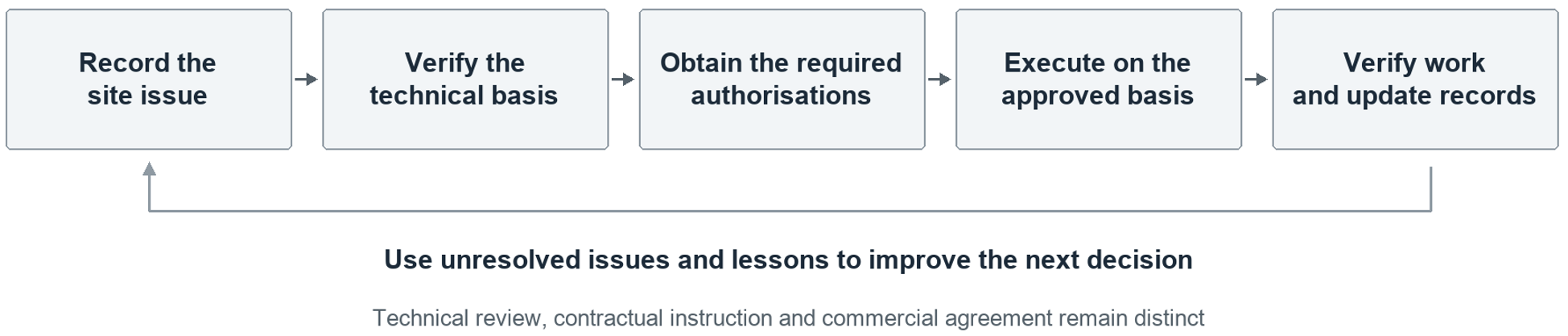
Adecore would map the change process against the actual contract and site responsibilities. The team would identify who can raise an issue, assess the technical options, authorise action, evaluate commercial consequences and verify completion. Notification requirements and time limits would be reviewed by the appropriate contract specialists. The digital workflow would support those obligations without presenting itself as a substitute for them.
A common issue record would connect the location or asset identifier, observation time, source evidence, relevant drawing revision and the question requiring a decision. It would preserve the distinction between reported condition and verified finding. The record would show the decision deadline and the consequence of waiting, so that urgent safety or programme concerns can be prioritised through the appropriate channels.
Technical options would be evaluated with their dependencies visible. A routing change may affect access for maintenance, fire protection, procurement or work already completed by another trade. The review would document which disciplines have checked the proposal and what remains unresolved. Where modelling or automated checks are used, their coverage and assumptions would be understood by the responsible professionals rather than treated as a general assurance of compliance.
The decision record would distinguish technical acceptance, contractual instruction and commercial agreement. These may occur at different times under the contract. Staff should be able to see which stage has been reached and what work is authorised. A controlled process for urgent action would protect immediate safety and preserve the evidence needed for subsequent review, without allowing routine ambiguity to be labelled an emergency.
Progress reporting would then connect execution to the authorised basis. Verification should be proportionate to risk and may require inspections, tests or other evidence beyond photographs. Differences between installed and approved work would remain visible until resolved. Cost reporting would distinguish submitted, assessed and agreed changes, helping management understand exposure without counting every request as an accepted liability or assuming every unresolved item will disappear.
We would pilot the workflow on a defined work package, measuring decision time, rework, missing approvals and the effort required to maintain records. Site users would test it under ordinary connectivity and workload conditions. The team would check whether earlier visibility actually enabled earlier decisions. If approvals still stalled, the remedy might be changed delegation or staffing rather than another software feature.
An effective review meeting would focus on decisions approaching their deadlines, with the evidence and responsible parties available. Repeatedly unresolved items would be examined for their cause: missing design input, unclear authority, commercial disagreement or insufficient resources. Each requires a different response. This makes the reporting rhythm useful to the site team and gives senior management a clearer view of where intervention can still prevent avoidable delay or expenditure.
Adecore Insight
The value of construction intelligence is often greatest before the concrete is poured, the equipment is ordered or a trade leaves the site.
The value of construction intelligence is often greatest before the concrete is poured, the equipment is ordered or a trade leaves the site. At those moments, the project still has choices. A disciplined information system preserves those choices by exposing uncertainty and directing it to people with the competence and authority to respond.
Its economic contribution should be assessed through avoidable rework, decision delay and the reliability of cost exposure. Its human contribution includes clearer instructions and better handling of conditions that require professional safety judgement.Institutional value lies in a record that survives staff turnover and allows the parties to understand why an action was taken. Environmental value may come from preventing wasteful changes, but reduced waste should be measured rather than presumed.
A good record does not eliminate legitimate disagreement. Parties may interpret the contract differently or dispute responsibility even when the facts are clear. Better evidence can, however, narrow the factual uncertainty and support earlier resolution. The system should not be sold as a guarantee against claims or as a replacement for competent project and contract management.
Adecore's emphasis would be on making information usable at the point of decision. The measure of success is whether site teams, professionals and commercial managers can work from a coherent account of what is known, what is authorised and what must happen next. That capability is more valuable than a dashboard that reports the problem accurately after the opportunity to prevent it has passed.