
A Weather Alert Is Only Valuable When a Farmer Can Act on It
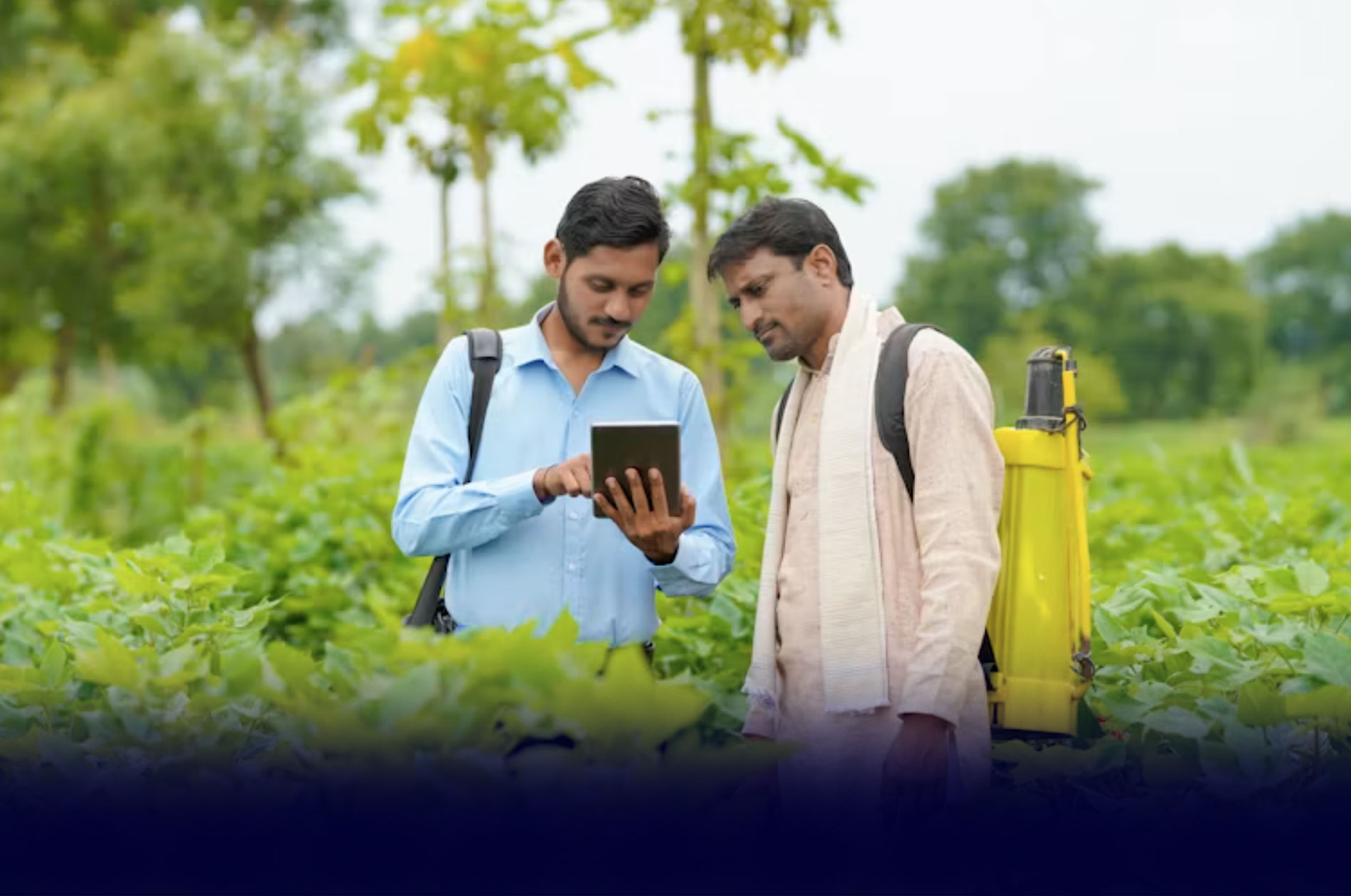
A farmer receives a message predicting rain. The message arrives quickly, in a familiar language, and appears precise. Yet the decision remains difficult.
Seed may already be in the ground, hired labour may be unavailable, and the field may drain differently from the surrounding area. Better information has reached the farm, but the means to use it have not necessarily arrived with it.
This is the central investment question for agricultural intelligence. Which decision will improve, for which farmer, within what time window? Real-time data matters when it reaches a person early enough to change an action that is both feasible and worthwhile. A faster forecast has little commercial value if every practical option has already closed.
On 18 September 2026, the Gates Foundation and Google announced an expanded initiative intended to bring AI resources to 200 million smallholder farmers across Sub-Saharan Africa and South Asia. Its roadmap includes climate information, agricultural mapping and language resources. That is an ambition for expanded reach, not evidence that 200million farmers have already achieved better yields or incomes.
For Adecore, the opportunity lies in connectingsuch capabilities to a dependable local service. The product is a betterfarming decision, supported by evidence, delivery capacity and a way to learnwhen advice fails.

The Challenge
Agricultural data describes different things at different scales. A forecast expresses a probability over an area and period.
Agricultural data describes different things at different scales. A forecast expresses a probability over an area and period. A field observation records a condition at a particular place and time. A farmer's account adds knowledge about planting, drainage or recent damage. Combining these inputs without preserving their differences creates confidence that the evidence cannot support. A precise location on a screen does not make the underlying prediction equally precise.
Timing compounds the problem. A reading collected yesterday may be adequate for one planning decision and unusable for another. The system should distinguish when something happened, when it was recorded and when the recommendation was issued. A communications outage can make old information look current when it finally synchronises. The farmer needs to know whether advice remains valid before committing scarce cash or labour.
Delivery also has an economic structure. Someone must pay for local observations, interpretation, communications, support and correction. A service funded through input sales may have incentives different from those of the farmer. A free pilot may become unaffordable once grant support ends. Commercial viability requires a clear account of who benefits, who pays and whether recurring revenue can sustain reliable assistance through an entire production cycle.
Data literacy is therefore part of the operating model. Adecore recommends the EMILI's Fundamentals of Farm Data programme addresses agricultural data, practical use, governance and cybersecurity. Its contribution is the emphasis on helping producers ask informed questions about technology investments. Applying that principle in Africa requires adaptation to local languages, devices, institutions and farming practices.
Trust is particularly vulnerable when advice is difficult to challenge. A farmer who sees a different field condition should have a channel to report it. If the system treats disagreement as user error, it loses both useful evidence and credibility. When the cost of a wrong recommendation falls on the household, uncertainty needs to be understandable before action, not explained retrospectively after a loss.
Our Approach
Adecore would begin with one consequential decision in a defined production setting. A cooperative might want to improve the timing of field visits following weather alerts.
Adecore would begin with one consequential decision in a defined production setting. A cooperative might want to improve the timing of field visits following weather alerts. The initial question would be whether combining local observations with forecasts helps extension staff prioritise visits more effectively. This bounded use case permits learning without presenting an automated message as a substitute for all agronomic judgement.
The evidence record would identify the field or service area, crop stage, observation time, source, geographic coverage and confidence limits. It would also record the action being considered, the time by which it matters and any missing information. An estimate remains labelled as an estimate. A field boundary generated from imagery would require appropriate verification for its intended use and would not be represented as proof of land ownership.
Before issuing advice, the service would test whether action is possible. Does the farmer have access to the required labour, equipment or extension support? If not, the response may be to arrange assistance or change the recommendation. A technically sound instruction that assumes resources the farmer cannot obtain can increase frustration without changing the outcome. Feasibility belongs inside the recommendation, alongside scientific plausibility.
Responsibility would be explicit. Local agronomic specialists would define the scope of approved advice and situations requiring escalation. The delivery team would set expiry rules, language checks and a process for withdrawing outdated messages. Farmers would have an accessible route to question advice and correct records. Commercial partners would disclose relevant interests, especially where recommendations could lead directly to purchases.
A pilot should measure the full journey from observation to action. Useful measures include how often information arrived before the decision deadline, whether intended users understood it, whether they could act and why they declined. Outcome evaluation should account for weather, crop mix and participant selection. Comparing willing early adopters with all other farmers would risk crediting the technology for advantages that existed before the service began.
The financial review would assess the cost per decision supported and the net value to the farmer after fees, additional inputs and labour. A service can be heavily used without being profitable for its users. The operating plan would include support staffing, replacement of faulty equipment, data protection and a continuity arrangement when connectivity fails. Local teams should be able to maintain the service and explain its limitations without permanent dependence on the original vendor.
The review should also record the cost of waiting for better evidence. A farmer may reasonably act on an uncertain forecast when the available alternatives are worse. The service should explain that choice in plain language, including what new observation would change the advice. This supports judgement under uncertainty rather than implying that responsible decisions always require certainty that agricultural conditions cannot provide.

Adecore Insight
The strongest agricultural AI proposition may be a modest decision service that works reliably in difficult conditions.
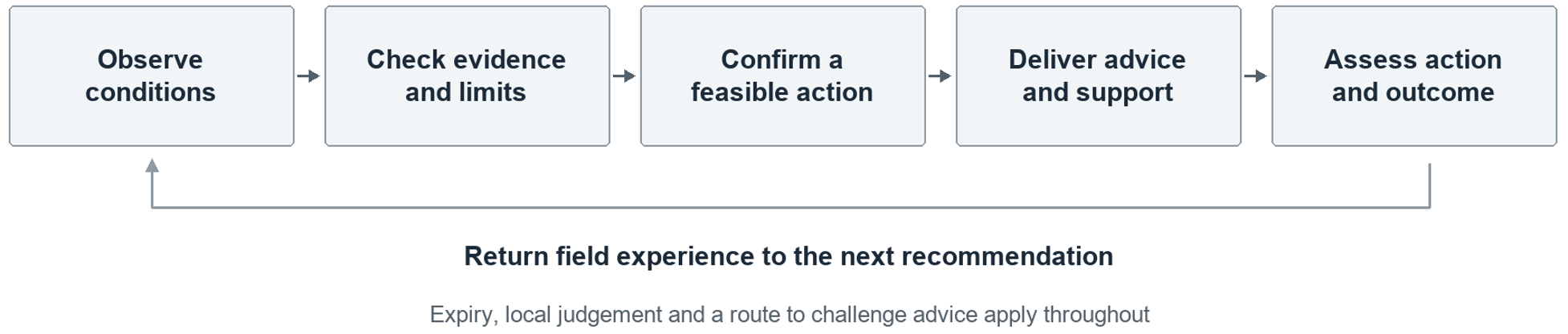
The strongest agricultural AI proposition may be a modest decision service that works reliably in difficult conditions. Investors should ask to see the chain connecting an observation to an understood recommendation, a feasible action and an assessed result. Registrations and message volumes demonstrate activity. They cannot establish that the farmer made a better decision or retained more income.
Human impact begins with agency. A farmer should understand the purpose of the service and retain a practical way to question it. Economic impact requires attention to net returns and downside exposure, particularly where the household borrows to act on advice.Institutional impact comes from capable local extension teams, accountable providers and records that can be corrected when reality contradicts a model.
Environmental impact must also be tested. A recommendation that reduces unnecessary water use in one setting may have little effect elsewhere, or may encourage expansion that raises total resource use. The assessment should consider both resource use per unit of output and the overall change where material. Benefits should remain unresolved until there is evidence to support them.
Adecore's test is whether intelligence expands a farmer's practical choices. The lasting asset is the local capability to interpret changing conditions, organise a response and learn from outcomes. When that capability survives a difficult season and the end of a pilot budget, digital agriculture begins to function as useful economic infrastructure.